
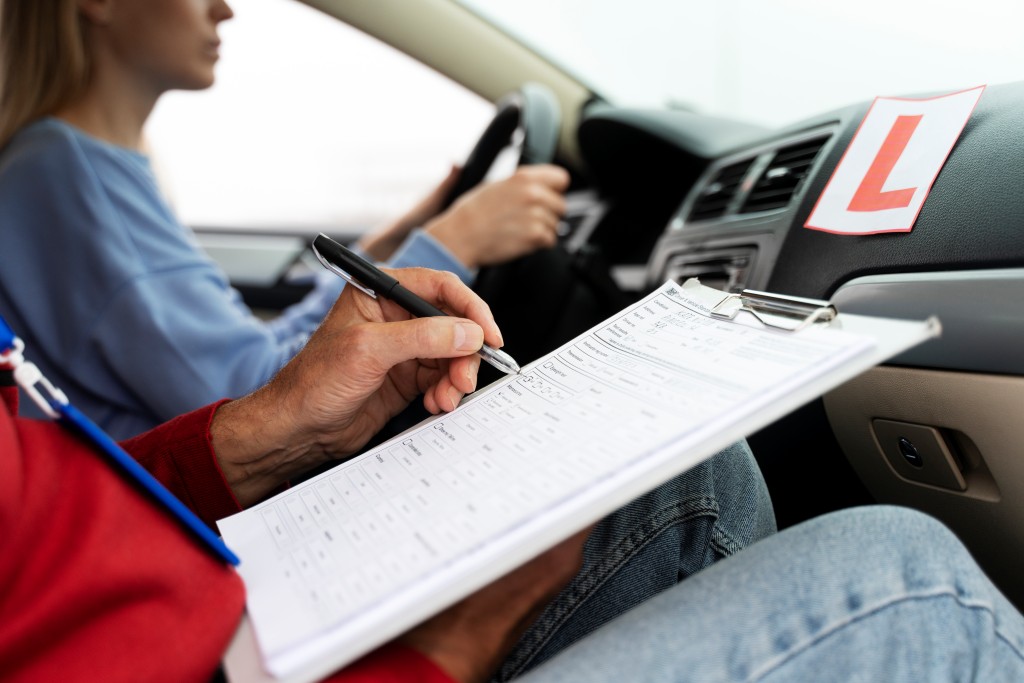
Preparing for the RSA driving test can be overwhelming, especially when you are not sure about the driving test questions that examiner may ask before the actual test begins.
Yes. The RSA driving test begins inside the test centre before the car even moves. The examiner checks your vehicle, insurance/roadworthiness and asks you questions on rules of the road, technical car controls and road signs.
However, passing the test is not about luck, it is about thorough preparation where you understand the process and meet the expectations of the examiner. The more time you invest in preparation, the higher the chances of passing the test in the first attempt. RSA is looking for a driver who is not just technically sound but fundamentally safe.
Driving Test In Ireland Goes Through Different Phases
- Oral Theory: Questions will be asked based on rules of the road, road signs, traffic lights, roundabouts, junctions and vehicle operations.
- Visual Identification Test: You will be asked to identify signs by shape and color.
- Under the Bonnet: Questions based on technical checks.
- In-Auxiliary Controls and Hand Signals: Questions based on Hand Signals and secondary controls.
In this guide, we have included most common RSA driving test Questions (with answers) to help you prepare for the test and give correct answers to the questions asked during the test to secure your license.
The Oral Theory Phase: Questions Asked Inside the Test Centre
After the RSA examiner carries out the vehicle checks, they will ask a set of theory and verbal questions at the beginning of the driving test – much before the car moves off. This phase includes a set of verbal questions where you are asked to identify the road signs, demonstrate hand signals to evaluate your knowledge on rules of the road and basic vehicle operations.
Core Rules of Road and Speed Limits
What speed limit applies to national roads?
Answer: 100 km/h
How fast can one drive on a dual carriageway?
Answer: 100 km/h
What speed limit applies on motorways?
Answer: 120 km/h
What is the speed on regional roads?
Answer: 80 km/h
Junctions, Right of Way and Roundabouts
What restrictions are applicable for a yellow box junction?
Answer: You should not enter a yellow box junction unless there is enough space to exit it immediately, except when turning right without blocking traffic.
What traffic has priority at a roundabout?
Answer: Traffic already on the roundabout has priority.
Should you stop fully at a stop junction?
Answer: Yes.
How far should you park a vehicle from a junction?
Answer: Over five metres.
Overtaking Techniques and Lane Usage
What should you avoid when a vehicle is overtaking?
Answer: Do not speed up.
When to take the right lane on a dual carriageway?
Answer: While turning right ahead or overtaking.
What is the exact lane to drive in on a dual carriageway?
Answer: Left Lane.
How much space you should keep when overtaking a parked vehicle?
Answer: Try to maintain a door length distance.
Road Markings and What Do they Convey
What do hatched road markings signify?
Answer: They are diagonal markings meant to diverge, separate, or merge traffic going in opposite directions. If you see such markings, avoid entering that area.
What road markings show a no entry restriction?
Answer: A broken white line and a continuous white line with words “No Entry”.
What does a solid white line (centre of the road) mark mean?
Answer: No overtaking and Marks strict dividing line that you must never cross or straddle.
Pedestrian Crossings and Traffic Lights
What does the amber traffic light indicate?
Answer: You should stop if it is safe to do so.
What does red flashing light indicate?
Answer: Railway crossing. Stop, train is approaching.
How far from a pedestrian crossing must you park?
Answer: Park 15 metres before crossing and five metres after crossing.
Why are zig-zag lines marked at pedestrian crossings?
Answer: These lines mean – No Parking or Overtaking.
Regulatory and Warning Signs: The Visual Identification Test
Learning road signs is important not just to clear your driving test but also for legal, smooth and safe driving. During the Visual Identification test, the examiner will test your knowledge of the rules of the road. You will be shown the visual cards for warning signs, regulatory signs, motorways signs, roadway signs and common road signs. The examiner will ask to explain the legal meaning of the signs.
Distinguishing Sign Types by Shape and Colour
What is the colour of motorway road signs?
Answer: Blue and White.
What does a warning sign look like?
Answer: Diamond shaped. Yellow background with information in black.
Why does a stop sign have its distinctive shape?
Answer: In case the sign is vandalised, one can still identify it.
Specific High-Frequency Sign Meanings
What does a right-angled pointer indicate?
Answer: It shows a dangerous corner ahead. It shows the driver which side the road is going to make a sharp turn.
What does this snake-like sign show?
Answer: It shows multiple bends ahead due to rough roads.
What does t-junction signs mean?
Answer: It indicates that the lane you are driving in will enter a new straight lane or merge into a carriageway where there is heavy traffic.
Under the Bonnet: Technical “Show Me, Tell Me” Questions
After the session of theory driving test questions is over, the examiner will conduct under the bonnet checks for the driving test. They will ask you to explain how you would check for windscreen washer fluid, brake fluid, oil, and coolant.
They will ask you to open the bonnet and show where each control is located. You do not have to conduct these technical checks physically, but just show where to check for each of them. For example, they may ask how would you check the level of oil and how would you check the level of the coolant etc.
Checking Vital Engine Fluids
How would you check if the engine has sufficient oil?
Answer: To check the levels, pull out the dipstick and dry it off and put it back in for a while. Now, pull out to check the level of oil mark between the minimum and maximum marks.
How would you check for adequate hydraulic brake fluid?
Answer: You would check the level of brake fluid against high and low levels.
How would you determine the coolant levels?
Answer: You can show the coolant reservoir and explain to the examiner that you will check the coolant levels by observing the high- and low-level markings.
Pre-Drive Technical Safety Checks
How would you ensure your tyres are in good condition?
Answer: I would check three factors:
- Tread depth: It should be 1.6mm
- General condition: check for cracks, bulges or cuts
- Tyre pressure: Will check the pressure recommended by the manufacturer.
I will check all four tyres along with spare tyre.
How would you check if your handbrake is working properly?
Answer: Pull it on. It should stay up.
How would you check the power steering?
Answer: With problematic steering wheels, you will find issues turning the wheel. Just turn off the engine. Now, try to turn the steering wheel. You will find it stiff. Once you turn on the engine, it will loosen and that’s the way you will know the power steering has started.
In-Car Auxiliary Controls & Hand Signals
After completing the “Under the Bonnet” phase, you will take the driver’s seat. At this stage, the examiner will ask a couple of questions about in-car auxiliary controls and hand signals before the actual driving test begins.
They may ask you to show and use internal controls like headlights, windscreen, washers, wipers, rear window heater, hazard warning lights and demister. Also, you may need to illustrate the common hand signals used for slowing down, stopping, turning right or turning left. It helps the examiner assess your familiarity with the vehicle and integral road safety protocols. Make sure you practice these signals and controls beforehand to answer the questions correctly and confidently.
Secondary Controls and Cockpit Drills
How to clean the front windscreen with wiper and windscreen washer controls?
Answer: Start the ignition (if required) and use the controls to clean the front windscreen.
How will you demist the front and rear windows?
Answer: Turn on the front heater blower and ensure that warm air reaches the windscreen area. Use the rear window demister to wipe the fog.
What checks should you perform starting your car?
Answer: You should check different aspects – seat, mirrors, head restraint and also fasten your seatbelts. Check if the doors are closed securely.
Mandatory Hand Signals
Which hand signal would you use to turn left?
Answer: Out of your car window, extend the right arm and then move it in an anti-clockwise direction.
Which hand signal would you use to turn right?
Answer: Put your right arm straight out of the window and point out clearly to the right.
Which hand signal would you use to stop or slow down?
Answer: Out of your car window stretch your right arm. Move it up and down while your palm facing downward.
RSA Marking & Grading: What Happens If You Answer Incorrectly?
The grading system depends on the faults and is categorised as follows:
- Grade 1 (Green) – Minor fault
- Grade 2 (Blue) – More Serious fault
- Grade 3 (Pink) – Dangerous/Potentially Dangerous driving behaviour ignoring traffic controls (failing the driving test)
The Grade 1 faults will not impact the result.
Grade 2 faults:
- 3 or more incorrect answers in Rules of the Road
- 3 or more incorrect answers in hand signals
- 3 or more incorrect answers in secondary controls
If you fail to operate a secondary control correctly during a practical test, it will be considered as a grade 2 fault.
Grades That Lead to Failing the Driving Test
- One or more Grade 3 faults
- 4 of the same grade 2 faults for a single aspect
- 6 or more grade 2 faults under the same heading
- A total of 9 or more grade 2 faults overall.
If your vehicle is found to be not roadworthy, it will lead to immediate cancellation of your driving test. The technical checks include majorly the tax, insurance, NCT discs, windscreen/window visibility, brake light and the physical tires. If the examiner finds any issues, the test will be considered as “Test Abandoned”, and you will still have to pay the test fee and then you must rebook. You can also follow a driving test checklist to make sure you are fully prepared before the actual driving test day.
Ready to Pass Your Driving Test Faster?
Book your Driving Lessons Tallaght today with experienced local instructors who understand the local test routes and common learner mistakes.